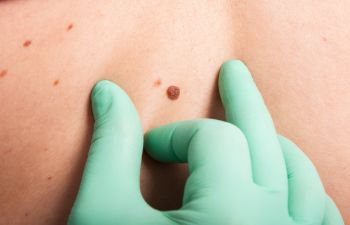
Though they are unusual in appearance and might resemble melanoma, Dysplastic Nevus is plural for “atypical moles” that often run in families and are noncancerous. Even so, The Skin Cancer Foundation is clear that individuals with atypical moles are at a greater risk of developing melanoma, and those with a high number of moles are at a higher risk for such. Moreover, dysplastic nevus are more prominent in Caucasians, as up to 8 percent of Caucasians have atypical moles. Though the presence of noncancerous moles is not always a concern, individuals are considered high-risk when there is a family history of melanoma.
Dermatologists and other skin care specialists agree that regular skin examinations are imperative for high-risk individuals, along with rigorous daily sun protection. In turn, it’s important to become aware of other conditions and syndromes that increase one’s risk of developing melanoma. For instance, individuals are considered to have Atypical Mole Syndrome when they have 100 moles or more, if one or more of the moles are 8 mm or larger, and if one or more of the moles are atypical. Along with atypical mole syndrome, individuals might have Familial Atypical Multiple Mole Melanoma Syndrome, or FAMMM, placing them at a higher risk. These individuals have one or more first or second-degree relatives that have presented with melanoma. Because people with FAMMM can develop atypical moles anytime throughout their lives, a commitment to regular skin examinations is key to early detection and treatment.
Careful consideration of one’s medical and family history, as well as the presence of atypical moles is necessary to determine the right approach to treatment. In some instances, monitoring atypical moles regularly is enough. Yet, in other cases, a biopsy is recommended or complete removal of the moles. Meanwhile, understanding when and how to use sunscreen is paramount. First, apply a broad- spectrum (UVA/UVB) sunscreen with an SPF of 15 of higher every single day. If you are going outside, apply sunscreen 30 minutes prior, and make a point to reapply sunscreen every two hours.
Do You Have A History Of Atypical Moles, Or A Family History Of Melanoma?
At Kayal Dermatology & Skin Cancer Specialists, our team believes that mole checks should be scheduled annually, beginning after age 30, and especially if an irregular mole has been detected previously or if there is a family history of melanoma.
If you’ve noticed a suspicious mole or lesion, or if you have a family history of melanoma, contact Dr. Kayal and the compassionate staff at Kayal Dermatology & Skin Cancer Specialists today.
Posted on behalf of
141 Lacy Street, Suite 200
Marietta, GA 30060
Phone: (770) 426-7177
FAX: (770) 499-0227
Email: kayaldermatology@gmail.com